
SPECTRUM MONITORING
Spectrum Monitoring focuses on the observation and analysis of radio frequency activity to protect operations, communications, and sensitive environments from unauthorized or harmful use of the electromagnetic spectrum.
It provides visibility into what signals are present, how they behave, and whether they align with expected and permitted activity.
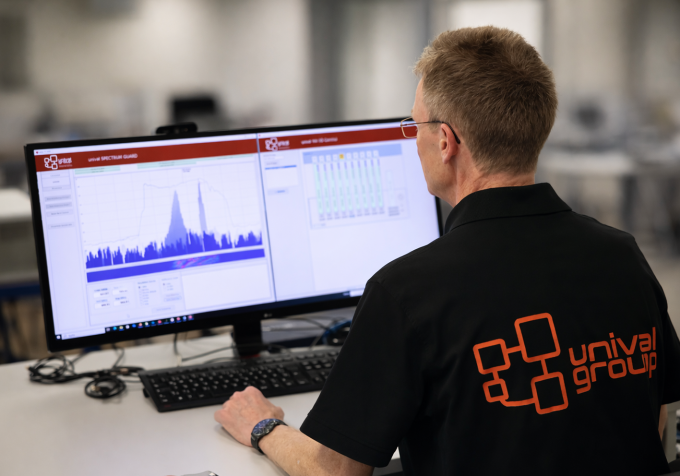

THE unival APPROACH
The unival approach to spectrum monitoring emphasizes awareness, control, and informed decision making. Rather than acting as a countermeasure, it establishes a clear picture of the radio environment, allowing operators to identify anomalies, assess risks, and determine appropriate responses within defined legal and operational frameworks.
Spectrum monitoring is a foundational element of counter monitoring and information protection. It supports prevention, investigation, and operational coordination by reducing uncertainty in complex wireless environments.
UNDERSTANDING unival SPECTRUM GUARD
The unival Spectrum Guard portfolio represents unival's integrated approach to counter monitoring, Technical Surveillance Countermeasures (TSCM), and information protection. It combines spectrum monitoring, signal analysis, physical detection tools, and access control measures to identify, locate, and mitigate unauthorized surveillance and communication threats.
The portfolio is designed to address both active transmissions and passive electronic devices, supporting continuous monitoring and targeted inspection operations.

Legal and Regulatory Notice: Use of spectrum monitoring, counter monitoring, and technical surveillance countermeasure systems is subject to applicable national laws and regulations. Deployment and operation are restricted to authorized security, governmental, and institutional users and must be conducted in accordance with local legal and regulatory frameworks.




Operational Applications
Spectrum Monitoring solutions are deployed wherever understanding and controlling radio frequency activity is critical to security and information protection.

Government and High Security Facilities
Monitoring of radio frequency activity to identify unauthorized or suspicious transmissions within secure compounds.

Critical Infrastructure and Industrial Sites
Protection of operational communications and detection of interference affecting safety or continuity.

Border Control and Sensitive Zones
Observation of cross boundary radio activity and detection of unauthorized emitters near controlled areas.

Ports, Airports, and Transport Hubs
Monitoring in dense wireless environments to maintain reliable communications and situational awareness.

Prisons and Correctional Facilities
Identification of illicit wireless activity within controlled detention environments under defined legal frameworks.

Event and Temporary Security Operations
Temporary spectrum monitoring during high profile events, summits, or security operations.

Technical Security and Counter Monitoring Operations
Support for audits, investigations, and counter surveillance activities.
The Threats Organizations Face
Organizations operating in complex wireless environments face risks that are often invisible without dedicated spectrum monitoring.

Unauthorized Wireless Communications
- Use of unapproved radios, mobile devices, or transmitters,
- Bypassing of controlled communication channels.

Interference and Signal Disruption
- Degraded reliability of critical systems.
- Loss of communication during time sensitive operations.

Information Exposure & Eavesdropping Risks
- Unauthorized monitoring of radio communications,
- Exposure of operational patterns or procedures.

Remote Coordination & Control of Threats
- Command and control of remote systems or devices,
- Coordination of actions across distances without physical presence.

Insider and Internal Process Exploitation
- Introduction of unauthorized transmitters,
- Circumvention of internal controls and procedures.

Lack of Situational Awareness in RF Environments
- Inability to distinguish normal from abnormal spectrum behavior,
- Delayed identification of emerging threats or anomalies.
How Spectrum Monitoring Helps
Spectrum Monitoring supports counter monitoring and information protection by delivering structured awareness and analytical insight into radio frequency environments.
SOLUTION

Support for Risk Based and Layered Protection
Enables proportionate response by linking spectrum awareness to threat assessment:
- Early identification of anomalies requiring attention.
- Input for escalation to investigation or countermeasure decisions.
- Integration into layered information protection strategies.


Visibility of the Electromagnetic Environment
Provides continuous awareness of radio activity within defined operational areas:
- Identification of active frequencies and signal sources.
- Establishment of normal operating baselines.
- Detection of abnormal or unexpected activity.


Protection of Communications and Operations
Supports the reliability and integrity of operational communication systems:
- Identification of interference affecting operational systems.
- Support for maintaining reliable and predictable communications.
- Reduction of blind spots in wireless environments.


Investigation and Technical Analysis Support
Provides technical evidence and insight for review and follow up activities:
- Collection of spectrum data for review and analysis.
- Support for technical investigations and audits.
- Improved understanding of radio related incidents.


Operational Oversight and Coordination
Supports coordinated monitoring and informed decision making across operations:
- Centralized or distributed monitoring based on operational needs.
- Support for coordinated response and decision making.
- Alignment with broader security and protection operations.

Operational Capability Overview


TECHNOLOGY CLASSES WITHIN UNIVAL SPECTRUM GUARD
unival Spectrum Guard systems can be grouped into the following technology classes based on their operational role within counter monitoring and information protection.
Spectrum Monitoring and Signal Analysis Systems
Fixed or portable platforms such as USG systems designed for continuous RF monitoring, signal classification, demodulation, and localization.
Handheld Counter Monitoring Instruments
Portable devices such as HCM1 used for rapid sweeps, localized inspections, and confirmation of transmitting sources during field operations.
Non Linear Junction Detection Tools
Specialized instruments such as NLJDmini used to detect passive electronic devices that do not emit signals.
Visitor Registration and Access Control Systems
Platforms such as uniXPASS that support information protection by managing and documenting physical access to secure environments.
Secure Communication Environments
Communication practices and systems designed to operate safely within counter monitored spaces, ensuring confidentiality under active surveillance detection conditions.


