
CHECKPOINT CONTAINER
Checkpoint Containers are integrated security inspection units designed to provide a controlled, self contained and relocatable environment for screening people, vehicles, baggage, and goods at fixed or temporary checkpoints.
They combine people screening, baggage screening, identification, and monitoring systems, operator workspaces, and supporting infrastructure within a transportable container format based on standard 20 foot or 40 foot containers, as well as custom dimensions.
These solutions are used where permanent buildings are not available, not practical, or not desirable.
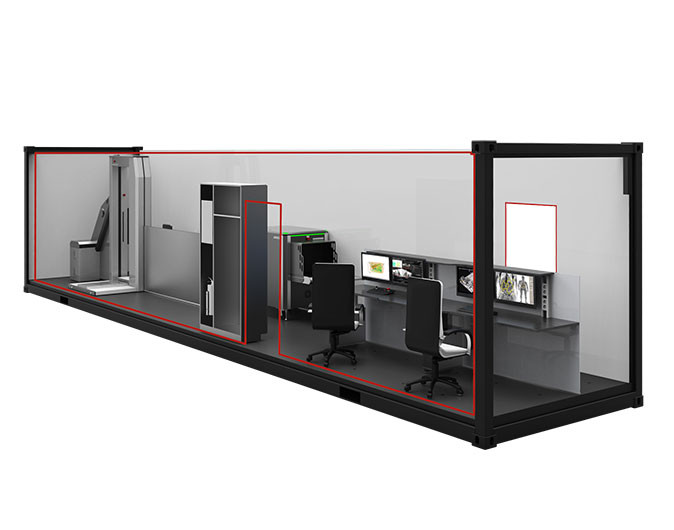
Checkpoint containers enable rapid deployment and redeployment of standardized screening capabilities while maintaining consistent operating conditions, safety, and procedural control. The internal layout can be configured to match specific operational needs, including traffic volume, threat profile, and site conditions.
Checkpoint Containers are commonly deployed at borders, ports, industrial sites, government facilities, and temporary security locations where flexibility and reliable screening performance are required. They support temporary, semi permanent, and long term installations and can be relocated as operational requirements change, depending on operational needs.
Operational Applications
Checkpoint Containers are deployed in environments where secure and structured screening must be established quickly or where flexible infrastructure is required.

Border Crossings and Customs Checkpoints
Deployment at land borders for people, vehicle, and goods screening in controlled inspection lanes.

Ports, Terminals, and Logistics Entry Points
Screening of personnel, vehicles, or cargo entering port areas, freight terminals, or logistics zones.

Critical Infrastructure and Industrial Sites
Access control and inspection at oil and gas facilities, power plants, construction sites, and other sensitive locations.

Government and High Security Facilities
Temporary or permanent checkpoints at government compounds, military installations, or secure campuses.

Event and Temporary Security Operations
Use at major events, summits, exhibitions, or temporary security perimeters.

Remote or Developing Locations
Deployment in areas with limited infrastructure where permanent buildings are not feasible.
The Threats Organizations Face
Checkpoint operations face a combination of access, inspection, and infrastructure related risks that require controlled and reliable screening environments.

Unauthorized Access and Intrusion
- Individuals attempting to enter restricted areas without authorization,
- Circumvention of access procedures at unsecured entry points.

Concealed Threats at Access Points
- Weapons, explosives, or prohibited items carried by individuals,
- Threats concealed in vehicles, baggage, or goods passing through checkpoints.

Vehicle Borne and Delivery Based Risks
- Use of service or delivery vehicles to introduce threats,
- Lack of structured inspection space increasing exposure

Operational Gaps and Inconsistent Screening
- Temporary checkpoints lacking standardized layouts or procedures,
- Inconsistent inspection quality due to poor working conditions.

Environmental and Safety Risk Exposure
- Exposure of personnel and equipment to weather, dust, heat, or poor lighting,
- Unsafe working conditions affecting inspection effectiveness.

Uncontrolled Crowd and Vehicle Movement
- Congestion caused by poorly organized vehicle and pedestrian movement,
- Increased safety and security risk during peak traffic or high volume periods.
How Checkpoint Containers Help
Checkpoint Containers support security operations by providing a controlled, standardized, and deployable inspection environment.
SOLUTION

Structured and Controlled Screening Environment
The checkpoint design establishes a clear and well organized layout that supports secure and orderly inspection operations:
- Defined inspection zones for people, baggage, and goods.
- Clear separation of public, inspection, and secure areas.
- Support for standardized operating procedures.


Rapid Deployment and Operational Flexibility
Checkpoint solutions are designed to be deployed quickly and adapted as operational requirements change:
- Quick installation without permanent construction.
- Relocation or reconfiguration based on changing operational needs.
- Suitable for temporary or long term deployment.
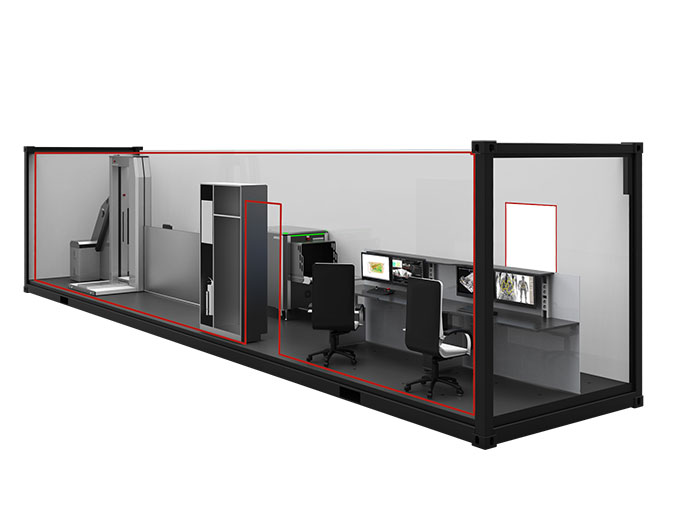

Integration of Screening Technologies
The infrastructure supports the coordinated use of multiple screening and access control systems within a single checkpoint:
- Accommodation of people screening, baggage screening, and access control systems.
- Prepared infrastructure for power, lighting, ventilation, and data connectivity.
- Support for integrated inspection workflows.


Improved Safety and Working Conditions
The working environment is designed to protect operators while supporting efficient and accurate inspections:
- Protected operator workspaces,
- Reduced exposure to environmental conditions.
- Improved ergonomics and visibility during inspections.


Consistency and Accountability
Standardized checkpoint concepts ensure uniform operations, clear oversight, and repeatable performance across locations:
- Repeatable checkpoint layouts across multiple locations.
- Support for training, supervision, and quality control.
- Improved documentation and oversight of checkpoint operations.
